Edwardsville, IL · Garage Door Service
When an Edwardsville Garage Door Is Worth Fixing
Edwardsville homes mostly date from the 1960s-70s building boom. Here's when a worn torsion spring or track is worth repairing and when the door itself has aged out.
- Repairs & new doors
- Springs & openers
- Serving 7 nearby communities
When It Stops Being a DIY Job
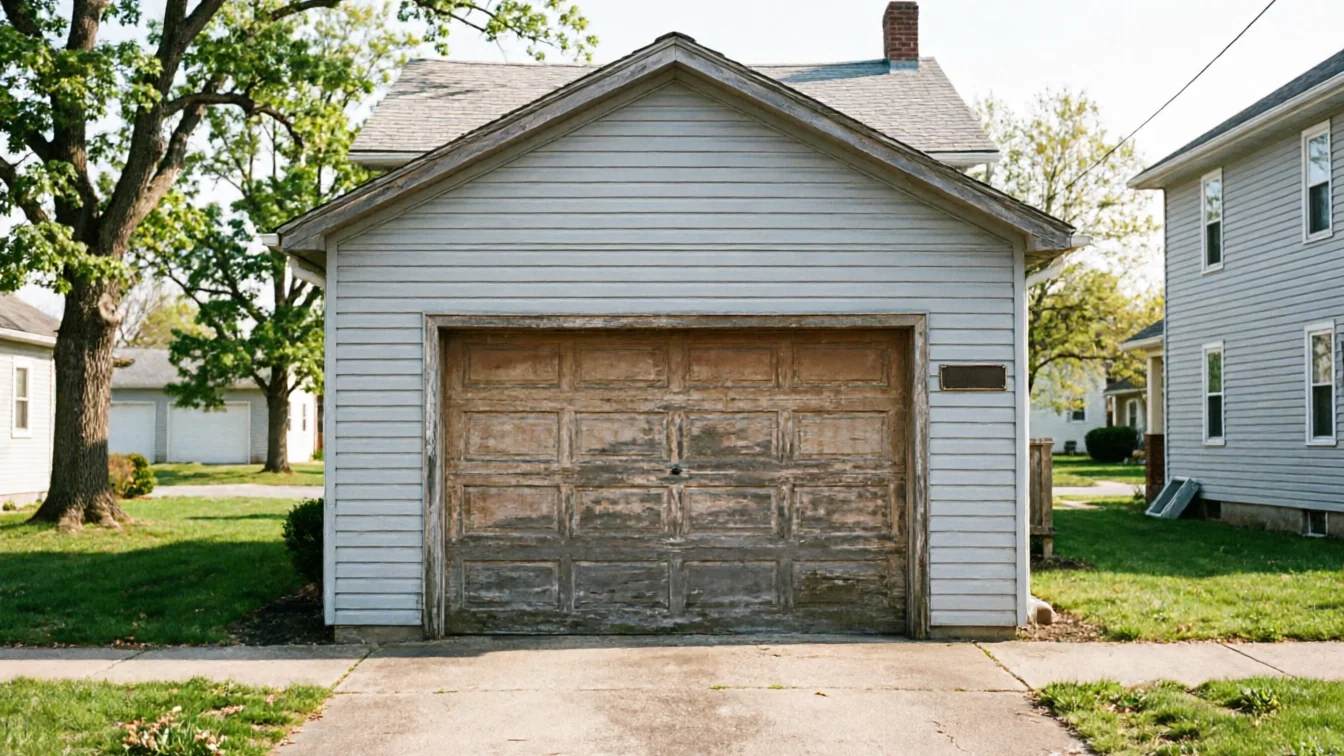
Most houses in Edwardsville went up between 1949 and 2000, with the bulk of the stock dating to the 1960s and 70s. That matters for repair decisions because a door from that era usually came with a torsion spring sized to a lighter, single-layer steel panel, and the hardware on it isn't what you'd pull off a shelf at a box store today.
Swapping a cable or adjusting a track bracket on a door like that is manageable for someone handy. A broken torsion spring is not. These springs store enough force to snap a ladder sideways or take off a finger, and on a door this old the winding cone and shaft may be undersized by current standards, which changes how the spring has to be wound and anchored. If the spring is gone, if the door won't stay up on its own, or if the opener is straining against a bind in the track, that's a call, not a weekend project.
Honest limitation: if your door is original to a house built before the 1970s, we sometimes can't get an exact-match panel or track bracket. In that case the right fix might be replacing the section, not matching it, and we'll tell you that up front instead of chasing a part that doesn't exist anymore.
How Local Conditions Play In
Edwardsville sits in a cold, moderate climate band, not the deep-freeze end of the Midwest but cold enough that steel contracts and grease stiffens every winter. A torsion spring that's already lost some of its temper from age doesn't fail gracefully in that kind of swing - it fails on the cold morning when the cable is tightest, not in the middle of a mild afternoon.
This is the piece that gets missed on a door that's otherwise in decent shape. Rollers and hinges on a 1960s or 70s door were often steel-on-steel, no nylon, no sealed bearing. Cold makes that friction worse, which means the opener works harder, which wears the gears inside it faster. None of that shows up as a single dramatic failure - it shows up as a door that's gotten noisier and slower over two or three winters.
A door built or replaced more recently, with sealed rollers and a modern spring rated for the panel weight, doesn't fight the cold the same way. That's the real dividing line for whether a repair is worth doing: not the door's appearance, but whether the hardware underneath it was built for one winter or forty.
What You Pay
We're not going to put a number here that doesn't hold up once a tech is standing in front of your door - what a repair costs depends on whether the spring, the track, or the opener is the actual problem, and on a door this age sometimes it's more than one of those at once.
What we can tell you is how the decision usually breaks: a worn roller or a bent track bracket on an otherwise sound door is a straightforward repair call, cheaper than you'd guess. A broken spring on a door from the 1960s-70s stock that's otherwise structurally fine is also usually worth fixing - the panel and frame outlast the spring by decades. Where it tips toward replacement is when the door itself has warped, the seams have separated, or the opener and the door are both failing around the same time, because then you're paying twice to patch two problems that both trace back to one door past its service life.
Ask for the breakdown before you agree to anything. A legitimate quote separates the spring, the labor, and any hardware upgrade so you can see what you're actually paying for.
The Problem
Across the Edwardsville area - and it's the same story a few miles over in Glen Carbon or Maryville, where the housing stock is just as old - the problem isn't that doors wear out. It's that a lot of them are wearing out at the same time, because they were all put up in the same twenty-year stretch.
With 51,342 owner-occupied houses in the service area and median household income here at $66,469, most owners are weighing a repair against a full replacement on a budget, not reflexively replacing at the first sign of trouble. That's the right instinct for a door that's mechanically sound. The problem shows up when people wait past that point - when a spring that's been noisy for a year finally lets go on the one panel that's also rusted through at the bottom, and now it's not one job, it's three.
The fix isn't complicated: get the spring and the rollers looked at before they fail outright, especially heading into winter when cold makes a weak spring worse. A five-minute look at a door that's starting to sag or stick costs a lot less than the call that comes in after it's stuck shut on a Tuesday morning.
Frequently asked questions
My garage door is from the 1960s. Can you even get parts for it?
Usually, yes, for the parts that wear - springs, cables, rollers, openers. Those get replaced with modern equivalents, not exact antiques. Where it gets harder is an exact-match panel or original track bracket; sometimes that's not available, and replacing the section is the more realistic fix.
Is it worth fixing a door that's original to the house?
Often yes, if the panel and frame are still square and the problem is the spring, cable, or rollers. Steel doors from the 1960s-70s stock in this area tend to outlast their original hardware by decades. If the panel itself has warped or rusted through, that's a different call.
Why did my spring break in winter and not summer?
Cold stiffens the steel and the grease in the hardware, and a torsion spring that's already lost tension from age is working at its limit right when it's least flexible. It's not random - winter mornings are when a weak spring is most likely to finally go.
Related garage door services in Edwardsville
More garage door guides
Book garage door service in Edwardsville
Call now or request a quote - tell us what the door is doing and where you are.